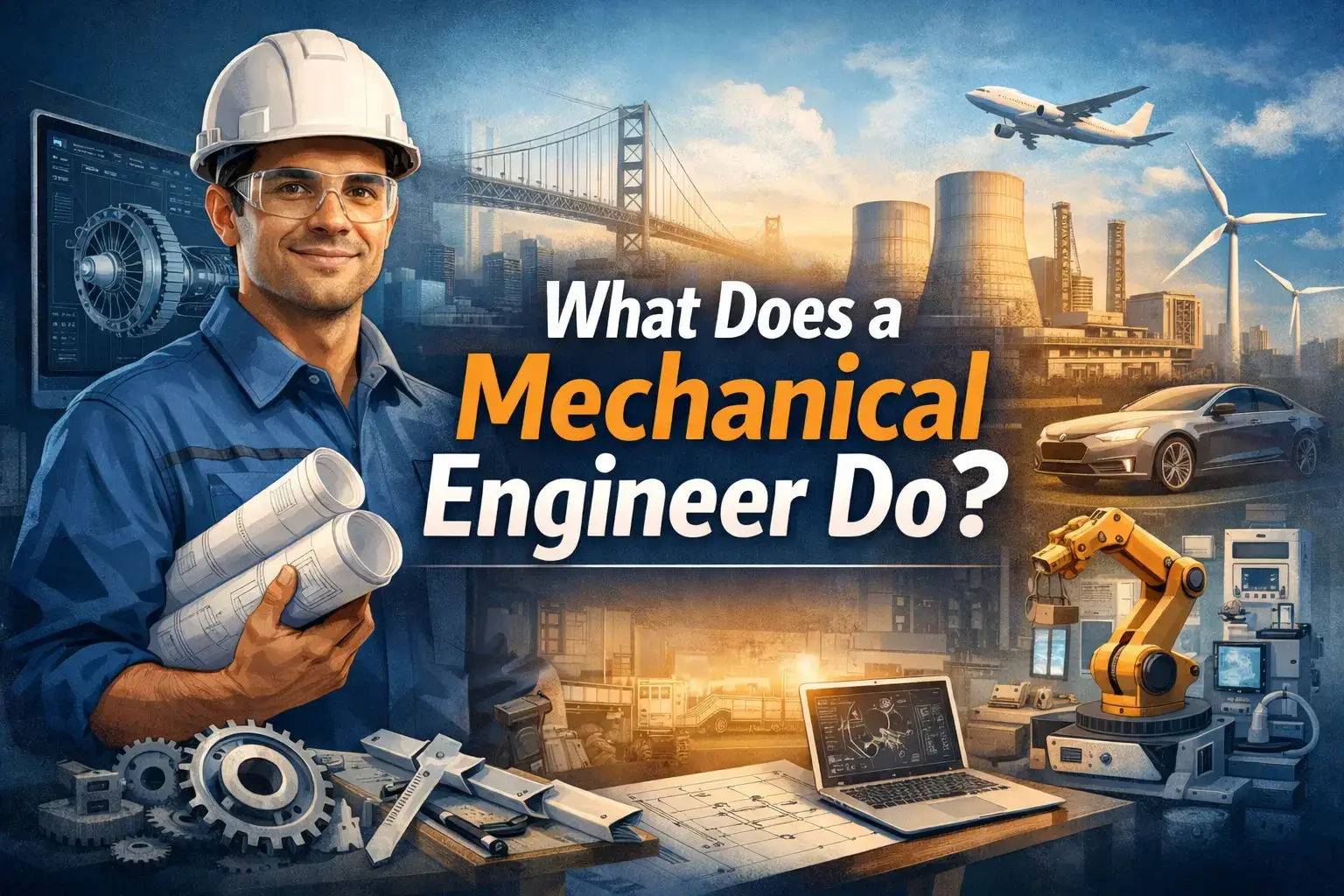


The situation demands that individuals interested in mechanical engineering work understand the specific responsibilities that mechanical engineers perform in their jobs. The United States hosts mechanical engineering as its most extensive fundamental engineering field, which spans the entire nation.
Mechanical engineers perform essential work for system design and machine development, which enables them to create and enhance the machines that people use every day. The operational activities of these specialists produce results that extend their effects across various business fields, which include transportation operations, energy production, healthcare services, and manufacturing facilities.
The guide provides a detailed overview of mechanical engineering responsibilities together with their professional duties, which demonstrate why this profession continues to support economic stability throughout the present time.
What Does a Mechanical Engineer Do?
Mechanical engineers solve real-world issues by applying their understanding of physical principles together with their expertise in material behavior and mathematical theories.

Mechanical engineers develop mechanical systems, which they improve to perform movement operations, generate power, maintain temperature, and complete physical work. The organization reaches its operational goals through self-sustaining systems, which ensure the complete safety of the entire system.
The product development process needs them to handle all stages between starting concept work and achieving finished product design, testing, production, and maintenance operations.
Core Responsibilities of a Mechanical Engineer
While specific duties vary by industry, most mechanical engineers share a common set of responsibilities.
Design and Development
One of the primary answers to what a mechanical engineer does is product and system design.
Mechanical engineers:
- Create design concepts and technical specifications
- Develop mechanical components and assemblies
- Use engineering principles to ensure performance and safety
This work often involves translating abstract ideas into practical, functional designs.
Analysis and Testing
Mechanical engineers must verify that designs will perform as intended under real-world conditions.
This includes:
- Analyzing stress, heat transfer, and motion
- Testing prototypes and evaluating results
- Identifying design flaws and performance limitations
Analysis helps prevent failures and ensures compliance with safety standards.
Manufacturing and Production Support
Another important aspect of what a mechanical engineer does is supporting manufacturing processes.
Mechanical engineers:
- Select appropriate materials and manufacturing methods
- Optimize production efficiency and cost
- Work with production teams to resolve technical issues
Their involvement ensures that designs can be produced at scale without compromising quality.
Maintenance and Troubleshooting
Mechanical engineers also help maintain existing systems.
This can involve:
- Diagnosing mechanical failures
- Improving system reliability
- Recommending upgrades or redesigns
Their expertise helps extend the lifespan of equipment and reduce downtime.
Industries Where Mechanical Engineers Work
Mechanical engineering skills are highly transferable across industries.
Manufacturing and Industrial Systems
In manufacturing, mechanical engineers design machinery, improve workflows, and ensure product consistency.
They focus on efficiency, safety, and long-term system performance.
Energy and Power Generation
In the energy sector, understanding what a mechanical engineer does includes working on power plants, renewable energy systems, and energy efficiency solutions.
Mechanical engineers help design turbines, engines, and thermal systems that generate and manage power.
Automotive and Transportation
Mechanical engineers are heavily involved in vehicle design and transportation systems.
Their responsibilities include:
- Designing engines and drivetrains
- Improving fuel efficiency
- Enhancing vehicle safety and performance
This work supports both traditional and emerging transportation technologies.
Aerospace and Defense
In aerospace, mechanical engineers design systems that must perform under extreme conditions.
They contribute to:
- Aircraft and spacecraft components
- Thermal and structural systems
- Reliability and safety analysis
Precision and compliance are especially critical in this field.
Healthcare and Medical Devices
Healthcare is another area where what a mechanical engineer does takes on unique importance.
Mechanical engineers help design:
- Medical devices and equipment
- Diagnostic and therapeutic systems
- Mechanical components used in patient care
Their work supports innovation while meeting strict regulatory standards.
Daily Work Environment of a Mechanical Engineer
The daily routine of a mechanical engineer varies depending on role and industry.
Office-Based Engineering Work
Many mechanical engineers spend significant time in an office environment.
Typical activities include:
- Creating and reviewing designs
- Running simulations and calculations
- Writing technical documentation
Collaboration with other engineers and project teams is common.
Hands-On and Field Work
Some roles require time in manufacturing plants, laboratories, or field locations.
This hands-on work allows engineers to:
- Observe systems in operation
- Conduct physical testing
- Address real-time technical challenges
This balance between theory and practice defines what a mechanical engineer does daily.
Education and Skills Required
Understanding what a mechanical engineer does also involves knowing the qualifications behind the role.
Educational Background
Most mechanical engineers hold at least a bachelor’s degree in mechanical engineering or a closely related field.
Their education covers:
- Thermodynamics
- Mechanics and materials
- Fluid dynamics
- Engineering design principles
Licensure may be required for certain roles, especially those involving public safety.
Technical and Professional Skills
Mechanical engineers rely on both technical and interpersonal skills.
Key skills include:
- Analytical thinking and problem-solving
- Attention to detail
- Communication and teamwork
- Project management
These skills help engineers work effectively across departments and industries.
Tools and Technologies Used by Mechanical Engineers
Modern mechanical engineering relies heavily on technology.
Engineers commonly use:
- Computer-aided design software
- Simulation and modeling tools
- Data analysis and testing equipment
These tools help transform ideas into validated, functional systems.
Career Growth and Opportunities
A key reason many people ask what a mechanical engineer does is to understand long-term career prospects.
Mechanical engineers can advance into roles such as:
- Senior engineer or technical specialist
- Engineering manager
- Project or operations leader
Some also move into research, consulting, or education.
Challenges Faced by Mechanical Engineers
Like any profession, mechanical engineering comes with challenges.
Common challenges include:
- Balancing performance, cost, and safety
- Meeting regulatory requirements
- Managing complex, multidisciplinary projects
Successfully navigating these challenges requires experience, adaptability, and continuous learning.
Why Mechanical Engineers Matter
Mechanical engineers contribute directly to economic growth, innovation, and public safety.
They help:
- Improve infrastructure and technology
- Increase efficiency and sustainability
- Solve practical problems that affect daily life
This broad impact explains why what a mechanical engineer does remains such a relevant question.
Conclusion
Mechanical engineers perform duties that involve the design and development of mechanical systems through their entire life cycle until they reach completion. Mechanical engineers develop mechanical system designs that they analyze before building them, and they work to improve system performance for current societal requirements.
The profession requires employees to work with different business sectors and technology systems while operating in different work environments, which creates a vital need for their services. Mechanical engineers apply their technical skills together with their ability to solve problems to develop essential systems that society needs for its daily operations.
The understanding of their duties reveals essential knowledge about the United States most impactful engineering field.