An EV charger load calculation adds the charging load to the load the building already has and checks the total against the rating of the electrical service. Under the 2025 California Electrical Code, each charger counts for at least 7,200 volt-amperes, charging is treated as a continuous load at 125 percent, and the existing load can be taken either from a calculation or from the building's recorded peak demand.
This guide covers what the calculation has to include, the two ways to establish the existing load, how energy management systems change the result, and what plan check asks for. The 2025 California Electrical Code is based on the 2023 National Electrical Code and took effect on January 1, 2026. The guide was checked on November 23, 2026 against the sources listed at the end.
What the calculation has to answer
One question: can the existing service carry the chargers, or does the service have to be upgraded? City checklists put it the same way. The City of Calabasas asks whether a new service panel is required based on the load calculation, and notes that the existing service has to be equal to or larger than the minimum required main breaker size. A service upgrade involves the utility, so the answer shapes the budget and the schedule of the project.
The three numbers in every calculation
- The charger load. Section 220.57 sets the load of electric vehicle supply equipment at a minimum of 7,200 volt-amperes, or the nameplate rating where that is larger. The City of Roseville prints the 7,200 minimum on its 2025 load worksheet.
- The continuous load factor. Charging runs for hours, so the charging circuit is sized at 125 percent. City checklists ask for 125 percent of the charging load in the service calculation as well.
- The existing load. Everything the service already feeds. This is the number with two possible methods, and the choice often decides the outcome.
Two ways to establish the existing load
| Method | How it works | When it fits |
|---|---|---|
| Calculated load, Article 220 | The existing loads are added up from the plans and the equipment, with the demand factors the code allows. | New buildings, and existing buildings with no usable demand records. |
| Recorded demand, Section 220.87 | The existing load is taken from the measured peak demand: one year of data, or at least 30 days of 15-minute interval data where a year is not available. The peak is multiplied by 125 percent and the new load is added. | Existing buildings with utility interval data. |
Recorded demand can come out well below a calculated load, because a calculation counts loads that rarely run together. One caution from the City of Daly City's handout: under Section 220.87, the peak demand data has to exclude solar and battery backup systems.
A worked illustration
The numbers below are invented to show the arithmetic. They are not from a project.
- Existing service: 400 amperes at 208 volts, three-phase.
- Recorded peak demand over the past year: 180 amperes. At 125 percent: 225 amperes.
- New load: six Level 2 chargers at 7,200 volt-amperes each, 43,200 volt-amperes in total. At 125 percent: 54,000 volt-amperes, which is about 150 amperes at 208 volts, three-phase.
- Total: 225 plus 150 is 375 amperes, under the 400-ampere rating of the service.
A calculated load for the same building could give a different answer. A real calculation also checks each panel and feeder between the service and the chargers, and the balance across the three phases.
When the service is short: energy management
An energy management system monitors the load on the service and controls the chargers so the total stays under a set limit. The City of Daly City cites Section 750.30 for it, and its handout shows what plan check expects when one is used:
- Documentation or manufacturer specifications showing the programmed limits.
- A panel rating and main breaker that match the load assumptions.
- A diagram showing all the managed loads and their wiring.
- Listed components, and labels on the managed circuits and control points.
- At inspection, a demonstration of the system if the inspector asks for one.
Simpler load-sharing devices let two loads share one circuit and allow only one to operate at a time. For the calculation, the principle is the same: where a load management system is used, the load that counts is the maximum the system permits, and the plans have to show that limit.
What plan check asks for
For chargers at an existing non-residential site, the City of Calabasas lists a full set of plans with:
- The electrical load calculation.
- A single-line diagram, showing any new or upgraded panel.
- A site plan, dimensioned and to scale, with the panel, the chargers, the accessible route and the parking stalls.
- The manufacturer's specifications and the listing mark of the equipment.
- Seismic calculations where the charging equipment weighs more than 400 pounds.
The same checklist goes beyond the electrical code. It asks about ground-fault protection for each EV receptacle, ventilation for indoor charging, the CALGreen sections that apply when the work increases the power supply to a service panel, and accessibility under Chapter 11B of the Building Code. For one to four charging stations, at least one has to meet the van-accessible dimensions. The accessible stall and its route often move the charger locations, so they belong in the first layout.
An example from our projects
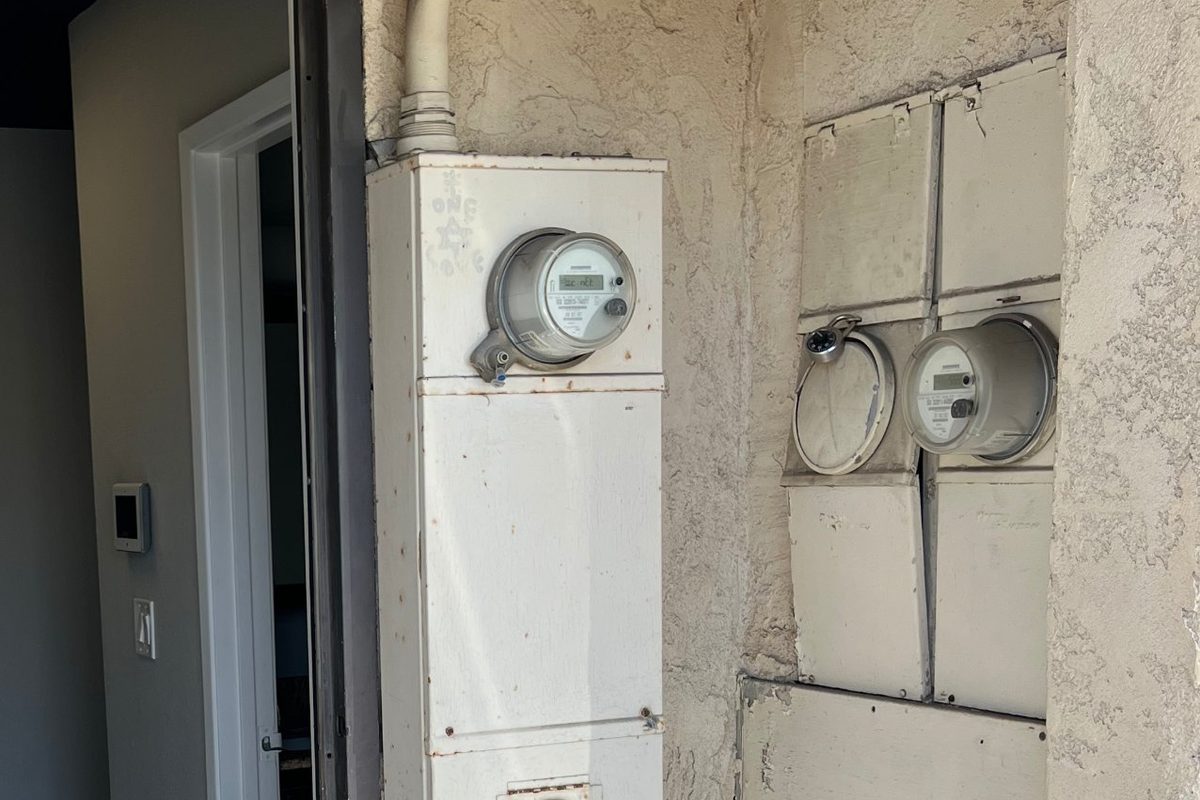
The first step is always the same: record what the existing service is. On an office tenant improvement in Los Alamitos, the field survey covered the bank of six electric meters that serves the second floor and the tenant panels they feed, and the electrical plans work from that record. An EV charger study starts from the same survey.
Common questions
How many amps does a Level 2 EV charger add to a load calculation?
The code minimum is 7,200 volt-amperes for each charger, or the nameplate rating if larger, and charging is counted as a continuous load at 125 percent.
Do I need a service upgrade to add EV chargers?
Only if the load calculation shows the existing service is too small. Recorded demand data or an energy management system can show capacity that a standard calculation does not.
What is Section 220.87?
The method that sets the existing load from the recorded peak demand: a year of data, or at least 30 days of 15-minute data, at 125 percent, plus the new load.
Can an energy management system avoid a service upgrade?
It can, where the system limits the total load to what the service can carry and the plans document the limit.
Is a load calculation required for an EV charger permit?
City checklists for Level 2 and larger installations ask for one, together with a single-line diagram.
How we help
We prepare electrical load calculations and the plans for EV charging stations at commercial and multifamily sites, as part of our electrical engineering scope. Send the single-line diagram or panel schedules if they exist, twelve months of utility interval data if it is available, and the number and type of chargers. Related reading: code-compliant electrical systems in California.
Sources
Checked November 23, 2026. This article is general information, not advice for a specific project. Requirements change over time, and cities apply them differently, so confirm them with the building department and the utility that serve your site.
- California Building Standards Commission, 2025 California Building Standards Code (Title 24), including Part 3, the California Electrical Code, Articles 220, 625 and 750
- City of Roseville, 2025 Electric Load Worksheet, revised January 1, 2026
- City of Daly City, Energy Management System and Load Shedding Devices, Plan Review and Inspection Guidelines, effective January 1, 2026
- City of Calabasas, 2025 Checklist for Installing Non-Residential Electric Vehicle Charging Stations at Existing Facilities
- City of Chino, Non-residential EV Charging Station Checklist
- City of San José, Electric Vehicle Charging Stations, plan requirements (page cites the 2022 code edition)
- Silicon Valley Clean Energy, Electric Service Optimization guide for building officials, updated May 8, 2024